Kav AI

Kav AI Platform · KAP v3.4

Active Physical Intelligence for asset integrity.

The first platform to close the loop between what sensors see, what process data says, and what engineering codes require — delivering risk decisions in hours, not weeks.

Real-Time Integrity Intelligence System
Kav AI Platform
The engineering challenge

Bridging industrial data silos

Three disconnected worlds. One major blind spot.

To analyze asset integrity, we must connect physical reality, process telemetry, and design bounds. Today, these live in completely isolated system and network silos, forcing engineering teams to spend up to 70% of their time manually compiling spreadsheets.

IT

Information Technology

<10%

Visual Data Silo: Less than 10% of captured visual/drone inspection imagery is ever reviewed by a qualified engineer. Lives on corporate networks, completely isolated from active process contexts.

OT

Operational Technology

$2M

Process Data Silo: Telemetry (pressures, temperatures, flow rates) lives behind secure, air-gapped firewalls. Gaps in historians hide progressive degradation, risking unplanned shutdowns costing up to $2M/day.

CAD

Engineering & Design

5–10d

Design Intent Silo: Structural 3D CAD design models and P&IDs live in document repositories. It takes 5 to 10 days of manual data-entry to cross-reference design codes and CMLs against field results.

Kav AI Platform
The platform

What Kav AI is

The integrity intelligence layer above existing systems.

KAP ingests visual inspection data, reads operational data from SCADA and process historians, and reasons across both in a persistent 3D model of the facility — continuously updating risk and recommending action.

What Kav AI is not

Not a hardware manufacturer.
Not a SCADA replacement.
Not a general-purpose industrial AI platform.
Read-only. Never writes to SCADA or control systems.
Kav AI Platform
How it works

Observe · reason · recommend

See, reason, recommend — in one system.

01

See

Multi-modal capture, normalised into a single photorealistic 3D model.

  • — RGB · Thermal · OGI
  • — Drone & confined-space fleets
  • — Autonomous robot patrols via KRSI (KAP Robot Sensor Integration)
  • — Fixed sensors & SCADA (read-only)
  • — P&ID, line-list, materials (CAD)

02

Reason

Multimodal AI correlates visual, thermal and process data against the integrity domain model.

  • — API 584 IOW classification
  • — API 571 damage mechanisms
  • — API 581 risk scoring + P90 life
  • — Stage 3.5 consistency gate
  • — Out-of-distribution detector

03

Recommend

Decisions surface in minutes via a natural-language interface — every action engineer-confirmed.

  • — Prioritised inspection plans
  • — CMMS work order packets
  • — Chat over the 3D model
  • — HITL sign-off required
  • — Full audit trail, timestamped
Kav AI Platform
System context

Purdue model & data flow

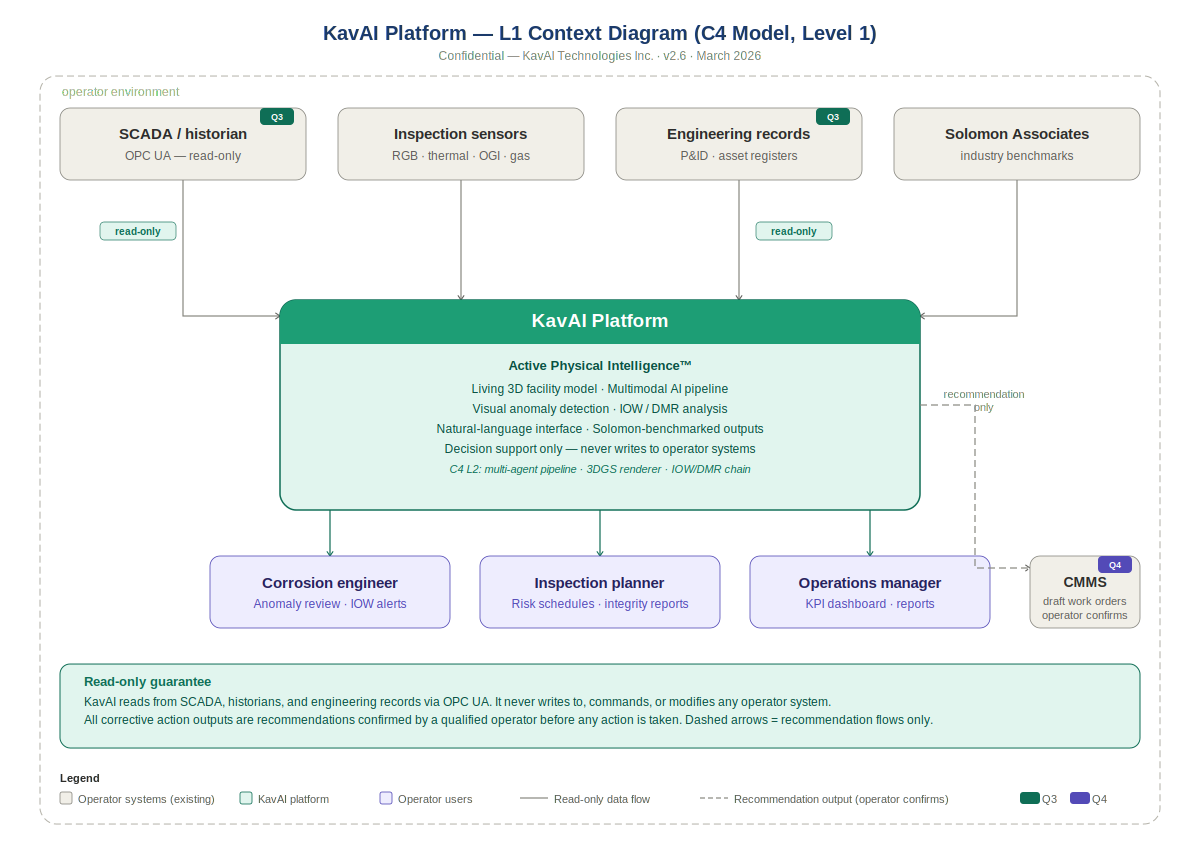
L1 System Context

KAP establishes a unidirectional, read-only perimeter. Physical sensor networks, robot fleets, and engineering design databases push up to our secure layer, while recommendations route through strict engineer validation (HITL) before reaching the plant CMMS.

Figure 1 Spec: Outlining the absolute boundary between operators, security zones, and external integrations.

Kav AI L1 Context Diagram
Kav AI Platform
The integrity chain

Integrity analytical chain

IOW → DMR → risk → inspection plan, continuously.

1

Normalise

Multi-source data QC'd with ±500 ms timestamp alignment.

2

IOW check

SCADA scored against API 584 limits by duration × intensity.

3

DMR

API 571 damage mechanism mapping, enriched with CAD context.

3.5

Cross-check

Campaign, patrol and SCADA evidence reconciled at the consistency gate.

4

Validate

Physical validation against UT, thermal, OGI and robot-sourced NDT.

5–6

Act

API 581 risk + P90 life → prioritised inspection plan & CMMS work order.

Result   Triage-to-work-order cycle reduced from 5–10 days to under 4 hours.

Kav AI Platform
Container architecture

Container & database schemas

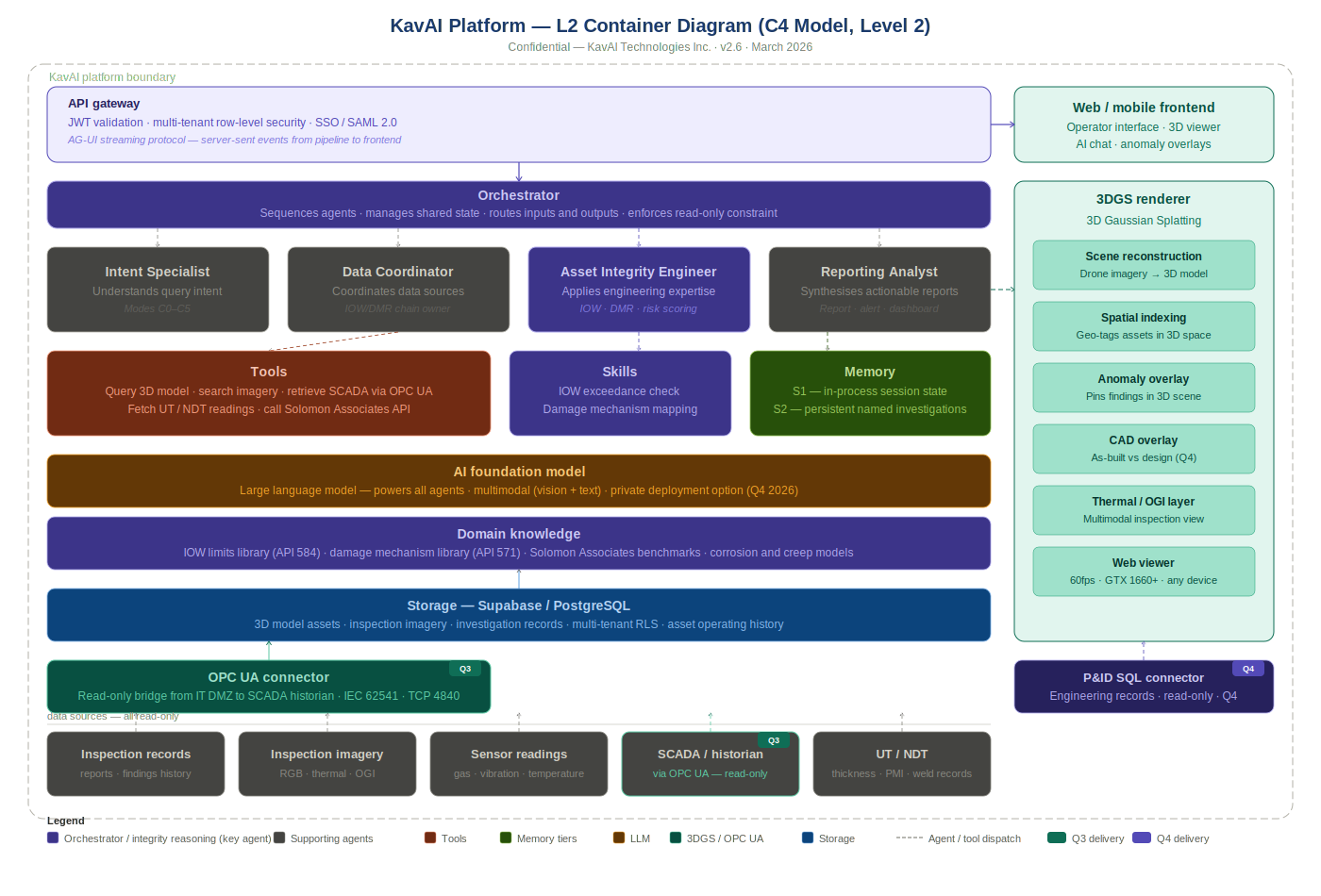
L2 Container Model

The internal platform topology isolates the 3D world model, process limits (IOW), and corrosion models (DMR) into decoupled containers. It illustrates how the cross-source correlation engine serves as the unified fan-in pre-stage feeding the consistency checks.

Figure 2 Spec: Highlighting the decoupling of the 3DGS photorealistic layer, the multi-source broker, and the core integrity engine.

Kav AI L2 Container Diagram
Kav AI Platform
The moat

Competitive position

Four layers. One system. No one else has all four.

Layer RBI incumbents
orKsoft · Meridium
Data fusion
Cognite · Hexagon
Autonomous capture
Percepto · Flyability
Kav AI
Visual inspection (multi-modal) partial
Photorealistic 3D (from drone imagery) needs LiDAR / CAD ✓ 3DGS
SCADA/IOW context (API 584)
Damage mechanism reasoning (API 571)
Deployment time 6–18 mo 6–18 mo weeks 90-day pilot
Kav AI Platform
Analytical boundaries

Equipment & mechanism thresholds

Explicit scope boundaries prevent model over-reach.

Equipment Class Automation Capability Rationale & Engineering Posture
Pressure Vessels & Exchangers Full API 581 Automation Primary M0/M1 asset focus. Heaviest source of corrosion-under-insulation (CUI) and standard IOW exceedances.
Piping Circuits Full API 581 Automation Mapped continuously via OPC UA SCADA process historical streams and Corrosion Monitoring Locations (CMLs).
Pressure Relief Devices (PRDs) Flag Only (HITL Required) PRD-specific methodology, requiring distinct consequence logic and specialized verification pathways.
Atmospheric Storage Tanks Flag Only (HITL Required) Tank floor inspection governed by unique mechanical standards (API 653) requiring offline manual entry.
Pipelines & Rotating Equipment Out of Scope (v1) Requires specialized inline inspection (ILI) data and vibration dynamics. Deactivated in standard reasoning modules.
Kav AI Platform
Sensor fusion

The noise filter

True spatial-temporal binning.

Drone, robot, and SCADA data are tagged, matches resolved within a 2-meter spatial radius, and scored across independent channels.

>98%

True Positive Rate (TPR) targets for multi-source confirmed insights.

<2%

False Positive Rate (FPR) targets achieved via cross-source corroboration.

Operational classification schema

Single-Source Detection

Vulnerable to transient environmental noise. Routed to standard severity-based triage.

Corroborated Finding (2 Sources)

Elevated priority with explicit evidence linking. Promoted to top of triage queue.

Multi-Source Confirmed (3+ Sources)

Bypasses manual verification queue for non-Critical severity items. Critical severity and Remaining Life changes always require engineer sign-off (v3.4 Canonical Rule).

Kav AI Platform
Guardrails & safety

Hallucination mitigation

Deterministic filter skills enforce reliability.

Given the high stakes of asset integrity, Kav AI rejects black-box LLM predictions. A strict multi-layered validation logic wraps the reasoning engine.

OOD Detection Cadence: The OOD detector identifies out-of-distribution inputs (sensor noise, physical layouts). Onboarded facilities run baseline campaigns during weeks 1-4 to calibrate the model, before production alerting is activated.

Three lines of defense

01 Susceptibility Filtering: A deterministic "Filter Skill" checks asset material and process fluids against hard-coded API 571 susceptibility matrices.
02 Stage 3.5 Consistency Gate: Reconciles materials, predicted corrosion rates, and visual evidence (e.g., CUI visual patterns must match thermal anomalies).
03 Uncertainty Flags: Outputs failing filters or with consensus scores <0.6 are tagged "UNCERTAIN - REVIEW REQUIRED" and frozen from dashboards.
Kav AI Platform
Persistent sensing

Beyond intermittent campaigns

Fixed infrastructure unlocks continuous coverage.

Rather than relying solely on high-cost per-robot onboard SLAM modules which degrade in repetitive piping systems, Kav AI pivots navigation to a site-amortized sensor mesh.

>= 20 h/day

Continuous, fleet-wide coverage across equipped site zones, delivering persistent physical tracking.

Localisation: SLAM vs. Fixed Mesh

Dimension Onboard SLAM Fixed Infrastructure
Reliability Degrades in piping Absolute (No drift)
~5cm with drift ~2cm anchored
Scaling Cost High (per-robot stack) Low (amortized across site)
Varies by fleet 5–15ms (Private 5G)
Kav AI Platform
Engineering design

Physical meets design intent

Deep CAD integration & change management.

Rather than treating inspection data as isolated pixels, Kav AI overlays the live photorealistic 3D world against engineering design files.

As-Built vs. As-Designed: Digital Twin Sync Service overlays 3DGS-derived as-built geometry against CAD design geometry, raising automatic notifications for pipe sags and structural shifts exceeding millimeter thresholds.

Per-format ingestion pipelines

IFC Open-standard extraction of geometry + engineering metadata mapped directly into KAP schemas (High Priority).
RVT Direct Revit extraction for structural model alignment and material classification (Medium Priority).
DGN Direct MicroStation / Bentley database extraction for piping design context to bypass Navisworks.
Kav AI Platform
IT infrastructure

Enterprise deployment models

Where data resides. How model reasoning scales.

01 / Cloud SaaS

Multi-tenant deployment managed on Kav AI's Google Cloud tenant.

  • — Fastest time-to-value
  • — Row-level security separation
  • — Live now (Alpha version)

02 / Customer Tenant

Containerized package inside customer Azure or AWS virtual private clouds.

  • — Retains full data sovereignty
  • — Standard enterprise updates
  • — Target release: Q4 2026

03 / Air-Gapped On-Prem

Fully on-premise inside the local LAN or OT/IT DMZ network.

  • — Local Llama-3-70B/Mistral-24.07
  • No external callbacks/licensing
  • — Hardware: 2x NVIDIA A100 (80GB)
  • — Target release: H1 2027
Kav AI Platform
Industrial ecosystem

Work processes

Bidirectional flows, not a parallel silo.

Kav AI fits directly into standard maintenance schedules. It pulls RBI baselines, updates operational corrosion rates, and writes rich evidence back to CMMS systems.

orKsoft Coexistence: orKsoft retains ownership of compliance records, CML thickness logs, and the master RBI plans. Kav AI digests those baselines as Stage 5 corrosion rate inputs, returning predictive risk adjustments.

Certified connector roadmap

01 SAP PM (Q4 2026): Highest market share at Tier-1 operators. Delivers direct evidence-packet CMMS work order generation.
02 Meridium APM (H1 2027): Standard integration with GE Vernova APM modules to read/write API 581 structural logs.
03 Hexagon ALI (H1 2027): Provides direct engineering design loop closure from spatial anomaly findings.
Kav AI Platform
MVP lineage · Core Workspace

MVP v0.1 · Platform Core & Web Workspace

Before CrewAI, Kav AI proved the inspection-data workspace.

The initial release established Next.js 15 app scaffolding, multi-tenant organizations, secure credentials configuration, and seamless user onboarding.

Timeline boundary

IN

App Start

May 12, 2025 · commit 835074a2 introduced Next.js app scaffolding and Supabase auth setup.

OUT

App Finalization

Oct 6, 2025 · commit d81a9ca6 marked complete web workspace finalization before agentic layers.

M0 boundary: web application only — no agentic CrewAI release scope.

01 · Identity

Auth & Tenant Shell

Public landing, login/signup, auth callbacks, protected app shell, org selection, invite flows, and membership checks.

02 · Data model

Dashboard & Datasets

Dashboard content, dataset creation, dataset tables/grids, detail pages, loading states, and error handling.

03 · Cloud storage & data

Secure Credentials

Custom secure Cloud Credentials form supporting Supabase model definitions, Azure SAS tokens, and Google Cloud Storage buckets.

04 · Settings & Setup

Onboarding & UI shell

Onboarding forms, user profiles, theme toggles, invite member forms, custom-styled Radix UI components, toasts, and alerts.

Kav AI
MVP lineage · Visualizations

MVP v0.1 · 3D Spatial & Multi-Sensor Visualization

High-fidelity rendering of spatial and telemetry datasets.

The core workspace features highly interactive visualization components: photorealistic 3D, COCO imports, side-by-side viewports, and gas mapping.

Multi-Sensor Stack

A

3DGS Spatial Anchoring

Cesium.js & Three.js loader for photorealistic 3D Gaussian Splatting and Google 3D Tiles.

B

Cross-Modal Juxtaposition

Synchronized dual-viewport for RGB and radiometric thermal imagery comparison.

Data integration: project COCO schemas and GIS gas sensor feeds onto the same workspace.

01 · Spatial 3D Environment

3DGS & Google Tiles

Navigable 3D Gaussian Splatting (3DGS) viewer using Cesium.js, Three.js, and Google 3D Tiles to render photorealistic facility scans.

02 · Multi-Format Dataset Hub

COCO Import & BBox

Upload and parse COCO JSON files to automatically project bounding boxes (`bbox`) and annotations via a canvas BoundingBoxVisualizer.

03 · side-by-side view

Cross-Modal Gallery

Side-by-side dual-viewport of RGB (visible light) and radiometric thermal imagery with fully synchronized zoom and pan controls.

04 · Multi-Sensor Telemetry

Gas Concentration

Visualize real-time sensor streams (methane, NO2, HCl, Cl2, H2) joined via v_dataset_gas_readings and mapped directly to GIS paths.

Kav AI
18 / M1 · MVP v0.2

M1 · MVP v0.2 · CrewAI Added

CrewAI turned the web app into an agentic reasoning workspace.

M1 ran from October 2025 to March 2026, transitioning from 3D data workflows into the first active, agentic reasoning pipeline.

Boundary evidence

IN

CrewAI Start

Oct 6, 2025 · commit d81a9ca6 introduced CrewAI to backend configuration & MCP testing.

OUT

M1 Completion

March 2026 · Concluded M1 development as focus transitioned into Q2 planning and M3 design.

01 · Agent Orchestration

CrewAI Multi-Agent Flows

Deployed the multi-agent cognitive architecture to replace static templates with sequential, task-driven reasoning flows.

02 · Backend Architecture

gRPC Subprocess Router

Ran multiple systems on port 8080 by routing traffic over gRPC loopbacks (:50051, :50052) as subprocesses managed by Supervisord.

03 · Structured Database

Supabase & MCP Context

Integrated backend agents with PostgreSQL tables (images, annotations, gas_readings) using Model Context Protocol (MCP).

04 · Cloud Infrastructure

GCP Multi-Container Run

Deployed Next.js as main app and kavai_server as a localhost sidecar inside a secure, autoscale-enabled GCP Cloud Run environment.

Kav AI Platform
19 / M2 · MVP v0.3

M2 · MVP v0.3 · Retrieval & Reliability

The data chat became reliable enough to support inspection work.

M2 introduced 3D CAD engineering asset alignment with Gaussian splats, alongside better retrieval, contextual chat, and recovery.

01

3D CAD Alignment

Linked structural 3D CAD models with photorealistic 3D Gaussian Splatting via manual and automated coordinate transforms.

02

Contextual Chat

Evolved conversation from generic Q&A into facility- and dataset-aware dialogue using strict, firewall-enforced SQL limits.

03

Modular Workspaces

Partitioned the platform frontend into Data Explorer and Integrity workspaces to separate generic data browsing from active triage.

04

Failure Recovery

Engineered auto-recovery for missing, empty, or malformed database tool results without disrupting the active, live user streams.

05

Comprehensive Tests

Built extensive E2E validation suites, multi-turn simulators, and programmatic unit-eval tests to secure pipeline reliability.

M2 outcome: operators can ask contextual questions against inspection data and get recoverable, test-backed answers.

Kav AI
20 / M3 · Decision workflow

M3 · PRD-aligned decision impact

M3 focuses on making the right integrity decision — not browsing more data.

The PRD frames Kav AI as decision support, utilizing modular workspaces (Data Explorer and Integrity) to transition smoothly from data browsing to active engineer validation.

PRD workflow path

A

Automated triage: anomaly, severity, confidence, source type, and asset identity.

B

Human validation: engineer selects Confirm, Dismiss, or Reclassify.

C

Escalation & audit: every decision is timestamped in the handover trail.

D

IDMS/CMMS packet: verified insights become work-order-ready data.

Decision rules from PRD

Kav AI supports decisions; it does not autonomously finalize critical integrity calls.

Critical outputs and Remaining Life adjustments require individual engineer sign-off.

Low-confidence alerts move to review; confirmed findings generate actionable-insight records.

Target: compress triage-to-work-order from 5–10 days to less than 4 hours.

Kav AI
21 / Strategic planning

Chronological deployment

Core milestones & MVP validations.

M0

MVP v0.1 · Web Application

Web app foundation only: organizations, datasets, image workflows, dashboards, and cloud-backed inspection data.

M1

MVP v0.2 · CrewAI Added

CrewAI-backed Supabase/MCP reasoning introduced the first agentic decision-context layer.

M2

MVP v0.3 · Data Chat Reliability

Improved retrieval, contextual data chat, failure recovery, and comprehensive test coverage.

M3

Decision Impact · PRD Workflow

Triage, engineer decision, audit, and structured IDMS/CMMS handoff.

MVP sequence validation

M0 / MVP v0.1: Web application only. (Delivered)

M1 / MVP v0.2: CrewAI added as the first agentic reasoning layer. (Delivered)

M2 / MVP v0.3: Retrieval, contextual data chat, failure recovery, and tests. (Delivered)

M3 / Decision Impact: PRD decision workflow — triage, HITL validation, audit, and IDMS/CMMS handoff. (Focus)

Kav AI Platform
Product requirements

What the integrity engineer needs

From inspection data to a defensible decision.

The product job: turn multi-source inspection data into grounded, audit-ready decisions an engineer can act on — and defend.

HAVE · EXTEND
Multi-sensor anomaly analysis. Detect and classify defects across thermal, OGI, and gas imagery.
NEW
Engineering context — CAD + asset metadata. Bring as-built / as-designed models and equipment metadata alongside the inspection.
NEW
P&ID ingestion. Connect each finding to its process line, tag, and instrumentation.
ROADMAP Q4
SCADA & live telemetry. Read-only OPC UA + historian (vibration, pressure, temperature) against integrity operating windows — the live signal that compounds the data moat. Moved to Q4: Q3 secures pilot data access.
BUILD
Actionable, ranked insights. Risk-scored recommendations — what to inspect first, and why.
BUILD
Custom, audit-ready reports. Zero-config PDF / Word, cited to standards and reproducible.
Kav AI Platform
Enterprise AI assistant

Architecture · the integrity engineer's assistant

Main modules: files, code, skills, memory.

Four living stores the assistant reads and writes — each engagement deposits all four. That is the data flywheel.

Files

File Perception

Typed lenses, not raw bytes — image, document (standards with citations), report, CAD, P&ID.

Code

Code & Execution

SQL today → sandboxed code to compute risk and generate reports. Code saved as the artifact of record.

Skills

Skill Repository

Governed markdown — human-curated, assistant proposes. Institutional knowledge.

Memory

Memory & Learning

Decisions, learned facts, preferences across sessions. Working knowledge — graduates into Skills.

Core Reasoning loop · tool dispatch · streaming.
Ground Anomaly → P&ID tag → CAD asset → standard. The value layer.
Report Audit-ready artifact + provenance bundle (code, inputs, citations).

Workspace & Artifact Store — object storage + metadata index the four stores sit on. Reuse, don't reinvent.

Enterprise Governance, Security & Audit — sandbox · RBAC · provenance · human-in-the-loop.

Kav AI Platform
Code Execution

Executing Agent-Generated Code

First Principles of Code Execution.

How do we safely and scalably run code written by an AI assistant?

Strict Isolation
Agents cannot share a kernel with host systems. A compromised agent must only compromise itself.
Data Proximity
Analyzing 100,000+ inspection photos requires zero-latency local file access. Downloading over the network is unscalable.
Ephemerality
Environments must boot instantly, run the task, and self-destruct. No lingering state or side effects.
Containment
Strict egress and network controls to prevent unauthorized data exfiltration.
Traceability
The exact script that ran to compute risk must be saved as the immutable artifact of record.
Kav AI Platform
Infrastructure

The Execution Sandbox

GKE Agent Sandboxes (MicroVMs).

Implementing the first principles via hypervisor-level isolation.

Hardware-Level Isolation

Each agent session boots inside a dedicated, lightweight Virtual Machine with its own guest Linux kernel. Host infrastructure remains entirely inaccessible.

Virtual Native Mounts

Petabyte-scale Azure Blob and Google Cloud Storage datasets are virtualized into the MicroVM using FUSE, streaming directly to the agent instantly.

Rapid Lifecycle

Boots a complete Ubuntu environment with auto-injected Supabase and API credentials in under 15 seconds.

Safe by Default

Agents have root access to their MicroVM, allowing them to install required dependencies without risking host nodes or neighboring tenants.

Kav AI Platform
Architecture Evolution

Execution Environments

Cloud Run vs. Agent MicroVMs.

Separating the orchestrator from the execution sandbox.

Current: Google Cloud Run

The Orchestrator

  • Paradigm: Serverless HTTP API endpoints (FastAPI).
  • Execution: Runs the trusted MAS orchestrators (CrewAI, LangGraph).
  • Limitation: Executing untrusted generated code within the API container risks memory leaks, process crashes, and credential exposure.
  • Storage: Difficult to dynamically mount multi-cloud FUSE filesystems (like Azure Blob) per request.

New: GKE Agent Sandboxes

The Execution Engine

  • Paradigm: Ephemeral, task-isolated Kubernetes Pods/VMs.
  • Execution: Runs the untrusted code and tools requested by the orchestrator.
  • Advantage: Dedicated guest kernel, precise resource limits (CPU/Memory constraints), and fast pause/resume capabilities.
  • Pooling: Support for "Warm Pools" allows pre-booting environments for sub-second agent allocation.
  • Storage: Full root privileges allow FUSE mounts of petabyte-scale datasets. Persistent Volume Claims (PVCs) act as dedicated $HOME folders, allowing agents to save work across multiple runs and sessions.

The Architecture: Cloud Run hosts the brain (API/Orchestrator). GKE MicroVMs provide the hands (Code Execution & Data Processing).

Kav AI
Strategic moat

The data moat

Every deployment makes the next one smarter.

Pillar 1

Mathematical foundation

Twenty years of active-learning science, turned into product. The reasoning core competitors can't shortcut.

Pillar 2

Active sensing

The system decides what to sense, when, and where. Live telemetry points the next inspection — sensing with intent, not passive capture.

Pillar 3

Data flywheel

Files, Code, Skills, Memory + SCADA compound per facility — proprietary, continuous, sticky. Irreplicable without the same integration.

The loop that compounds

Inspect → Find → Correlate with live SCADA → Decide → Capture outcome → Sharper models ↻

Kav AI Platform
Appendix / Analytical pipeline

Backup Slide

IOW/DMR Analytical Pipeline Details

While SCADA connection is planned for later phases (Q4), the 6-stage analytical pipeline is pre-designed to connect raw physical telemetry (OPC UA) to automated risk models (API 581) once the datastream becomes active.

1

Ingestion & QC

Normalizes OPC UA feeds; handles stale tags and gaps inside ±500ms alignment window.

2

IOW Check

Compares SCADA telemetry against API 584 bounds by duration × intensity.

3

DMR Mapping

Maps exceedances to API 571 mechanisms, leveraging CAD metadata.

3.5

Consistency Gate

Three-way validation of material, predicted corrosion rate, and cross-source evidence.

4

Validation

Cross-references damage maps with UT scans, OGI leaks, and robot telemetry.

5-6

Risk & Action

Applies API 581 Damage Factors to score risk → CMMS work orders.

Kav AI Platform
Architectural posture

Backup Slide

Observe, reason, and recommend. Only.

Kav AI maintains a strictly read-only OT posture. It intercepts, ingests, and analyzes physical reality, process telemetry, and design bounds inside a persistent 3D model, but it never commands valves, acts, or writes to control networks.

Technical Boundary: Outbound-only connection initiation supported from OT to satisfy strict "no-inbound" firewall architectures.

Read-only technical enforcement

01 Service Restriction: OPC UA client credentials restricted on servers to 'Read' and 'Subscribe' services only.
02 DMZ Rejection: Secondary DMZ reverse proxy / aggregator technical rules configured to actively reject all Write/Call requests.
03 Port Restriction: Hardened firewalls blocking all traffic outside TCP/IP port 4840 (OPC UA) and 4843 (secured).
Kav AI Platform
Analytical rigor

Corrosion Rate (CR) Provenance

A

Level A (Measured)

Derived from localized ultrasonic testing (UT) trend data at specific Corrosion Monitoring Locations (CMLs).

B

Level B (Modeled)

Derived from process-specific chemical models (pH, CO₂, H₂S, velocity) if UT data is stale (>12 months) or absent.

C

Level C (Generic)

Standard API 571 / API 581 material susceptibility guidelines inside nominal operational boundaries.

Backup Slide

Probabilistic P90 Remaining Life metrics.

Deterministic models fail on safety reviews because they ignore measurement tolerance. Kav AI propagates input variance across the entire analytical loop.

RL = (t_actual - t_min) / CR

Where t_actual carries a ±0.1–0.5mm ultrasonic tolerance, t_min is calculated per ASME B31.3/API 570, and CR uncertainty is scaled by its Level A/B/C provenance.

Kav AI Platform
Technical glossary

Backup Reference

Kav AI Platform Technical Glossary

Standard engineering acronyms, domain vocabulary, and machine learning terminology utilized across the KAP product architecture.

Operational Networks

IT / OT Subsystems

Information Technology (corporate networks) and Operational Technology (industrial controls, SCADA, PLCs) logically separated per the Purdue model.

IDMZ (Industrial DMZ)

A secure network perimeter subnetwork (Level 3.5) preventing direct traffic exchanges between untrusted corporate IT and highly trusted OT control networks.

CMMS (Work Orders)

Computerized Maintenance Management System (e.g., SAP PM, IBM Maximo) used by facilities to log assets and dispatch official repair work orders.

Integrity & Compliance

IDMS (System of Record)

Inspection Data Management System (e.g., pcMS, Visions) holding historical NDT thickness measurements and mechanical compliance records.

APM (Performance)

Asset Performance Management (e.g., GE APM/Meridium) analyzing asset health scoring, failure prediction, and statistical reliability over time.

RBI (Risk-Based Inspection)

Methodology prioritizing equipment inspections based on computed Probability of Failure (POF) and Consequence of Failure (COF) per API 580/581.

Core KAP Technologies

3DGS (Digital Twins)

3D Gaussian Splatting, a neural rendering technique creating navigable, photorealistic 3D twins directly from standard drone inspection imagery.

OOD (ML Reliability)

Out-of-Distribution detector that flags raw sensor inputs, metals, or operating bounds that fall outside the model's training parameters.

KRSI / OPC UA

Robot telemetry broker normalizer (KRSI) and unified industrial communication standard (OPC UA) used for secure machine-to-machine telemetry feeds.